
Key Takeaways
- In 2020, there were 2,681 new mesothelioma cases in the United States — a rate of 0.7 per 100,000 people, according to CDC data.
- Men accounted for 1,900 of those cases (1.1 per 100,000) compared to 781 cases in women (0.4 per 100,000). This gap is driven by historically male-dominated asbestos industries — not by biological susceptibility. When exposed to equal amounts of asbestos, men and women are equally at risk.
- White, non-Hispanic Americans represented the vast majority of cases — 2,223 of 2,681 — followed by Hispanic (218), Black non-Hispanic (133), and Asian and Pacific Islander (77) populations.
- Mesothelioma overwhelmingly affects older adults. The 75–79 age group had the highest case count (543), and the majority of diagnoses occurred in people aged 65 and older. There were fewer than 16 cases in every age bracket under 35.
- This age pattern reflects mesothelioma’s 30- to 40-year latency period — meaning most people diagnosed today were exposed to asbestos decades ago, often during their working years.
Cancer can affect anyone, regardless of race, ethnicity, gender, etc. That being the case, some people are more susceptible to some cancers than others. Those who have been exposed to asbestos are at risk of developing mesothelioma, a rare and aggressive form of cancer that usually affects the pleura, or the lining of the lungs. Men tend to be diagnosed with mesothelioma more than women, as historically they worked in jobs that are more associated with asbestos, such as shipbuilding, construction, insulation, firefighting, etc.
Rates of New Mesothelioma Cancers, Men and Women
The CDC provided statistics on the rate of new mesothelioma cases in the United States from the year 2020. The CDC’s information shows that men do indeed develop mesothelioma more frequently than women. In general, in 2020, .7 per 100,000 men and women were diagnosed with mesothelioma and there were 2,681 new cases in the US that year. In comparing men and women, 1.1 per 100,000 men were diagnosed with mesothelioma in 2020, totaling 1,900 new cases. .4 per 100,000 women were diagnosed with mesothelioma, totaling 781 new cases. Based on this evidence, it is clear that men are more likely to develop mesothelioma, however this is not because they are more susceptible. Men and women are just as likely to get mesothelioma when exposed to the same amounts of asbestos, however, as previously mentioned, asbestos was used in the past in male dominated jobs.
Rates of New Mesothelioma Cancers, by Race and Ethnicity
When it comes to rate of new mesothelioma cases by race and ethnicity for men and women, white, non-Hispanic people represented the most mesothelioma cases in 2020, followed by Hispanic people, Black non-Hispanic people, and Asian and pacific islanders (non-Hispanic).
White Americans represented almost all the cases of mesothelioma. .7 per 100,000 white Americans were diagnosed with mesothelioma, totaling almost all the cases at 2,223 new cases.
Based on what the CDC had data for, .5 per 100,000 Hispanic people were diagnosed with mesothelioma, totaling 218 new cases.
Additionally, .4 per 100,000 Asian and Pacific Islanders in the US were diagnosed with mesothelioma, totaling 77 new cases.
Lastly, .3 per 100,000 Black people were diagnosed with mesothelioma, coming out to 133 new cases.
This data is not all inclusive as it did not provide information on Native Americans and Alaska Native individuals.
Rates of New Mesothelioma Cases by Age
The data also highlights the fact that older people are way more likely to develop mesothelioma than those that are not yet of retirement age. This is because mesothelioma has a long latency period of 30-40 years, meaning the cancer will normally not begin to develop until decades after exposure to asbestos. In fact, there was not even enough data available to report cases on those that were 34 or younger as these age brackets had less than 16 cases each.
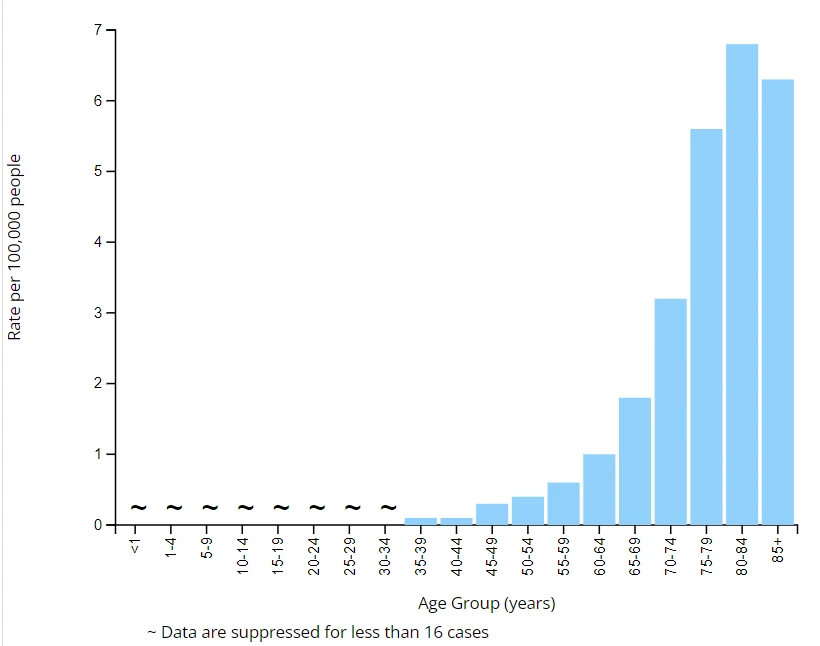
USCS Data Visualizations – CDC
Of the 2,681 new cases in 2020, 35-39 year olds represented only 23 cases, 40-44 year olds represented 25 cases, 45-49 year olds represented 49 new cases, 50-54 year olds constituted 70 cases, 55-59 year olds constituted 134 cases, 60-64 year olds constituted 207 cases, 65-69 year olds constituted 308 cases, 70-74 year olds amounted to 459 cases, 75-79 year olds amounted to 543 cases, 80-84 year olds amounted to 428 cases, and 85+ year olds amounted to 409 of the cases.
When it comes to the data combining race, sex, and ethnicity, it is evident that men, no matter what race and ethnicity, represented most of the cases in, not matter race or ethnicity.
If you or a loved one has been diagnosed with mesothelioma, or another asbestos-related disease, please call (800) 505-6000. We can help you and your family get the compensation you deserve. For more information fill out the form on our Homepage.
Frequently Asked Questions
How many people are diagnosed with mesothelioma each year in the United States?
According to CDC data from 2020, there were 2,681 new mesothelioma cases in the United States that year — a rate of 0.7 per 100,000 people. Mesothelioma remains a rare cancer, but its aggressive nature and long latency period make it a significant public health concern, particularly in communities with histories of industrial asbestos use.
Why do more men get mesothelioma than women?
In 2020, men accounted for 1,900 cases compared to 781 cases in women. This is not because men are biologically more susceptible — research shows that men and women are equally at risk when exposed to the same amounts of asbestos. The disparity is driven by the fact that asbestos was historically used in male-dominated industries like shipbuilding, construction, insulation, and firefighting, resulting in far higher rates of occupational exposure among men.
Does race or ethnicity affect mesothelioma rates?
CDC data from 2020 shows that mesothelioma rates do vary by race and ethnicity:
- White, non-Hispanic — 0.7 per 100,000 (2,223 cases)
- Hispanic — 0.5 per 100,000 (218 cases)
- Asian and Pacific Islander — 0.4 per 100,000 (77 cases)
- Black, non-Hispanic — 0.3 per 100,000 (133 cases)
These differences likely reflect historical patterns of occupational exposure across different communities rather than biological factors. The CDC data did not include information on Native American and Alaska Native individuals.
What age group is most commonly diagnosed with mesothelioma?
The vast majority of mesothelioma diagnoses occur in adults aged 65 and older. The 75–79 age group had the highest number of cases in 2020 with 543 diagnoses, followed by the 70–74 group (459) and the 80–84 group (428). There were fewer than 16 cases in every age bracket under 35. This pattern is consistent with mesothelioma’s long latency period of 30 to 40 years — meaning most patients were exposed to asbestos decades before their diagnosis.
Why does mesothelioma mainly affect older adults?
Mesothelioma has an unusually long latency period of 30 to 40 years. After asbestos fibers are inhaled, they become embedded in tissue and cause slow, progressive cellular damage over decades before the cancer develops. This means that people who were exposed to asbestos in the 1960s, 70s, or 80s — when asbestos use was widespread and regulations were limited — are the ones being diagnosed now, typically in their 60s, 70s, and 80s.
How does Pennsylvania compare to the rest of the country for mesothelioma rates?
Pennsylvania has historically been one of the highest-risk states for mesothelioma due to its concentration of asbestos-heavy industries — including steel mills in Pittsburgh and Bethlehem, the Philadelphia Naval Shipyard, power plants, oil refineries, and the asbestos manufacturing operations in Ambler, Montgomery County. The state’s industrial legacy means that thousands of Pennsylvania workers and their families were exposed to asbestos over multiple decades, and new diagnoses continue to occur as the latency period catches up with those exposures.
What should I do if I or a loved one has been diagnosed with mesothelioma?
If you or a family member has been diagnosed with mesothelioma or another asbestos-related disease, understanding your treatment options and legal rights is a critical first step. Your exposure history — where you worked, which products you were around, and for how long — may be central to building a legal claim. Call (800) 505-6000 or fill out our contact form to get help for you and your family.
